← The Weekend Getaways
🏛️ CulturalLong weekend · from Atlanta, GA

Chattanooga: Civil War Battlefields, Mountain Views & American Art

Two hours north of Atlanta, Chattanooga sits in one of the most dramatic natural amphitheaters in the eastern United States, ringed by mountains where the Civil War's decisive western campaigns were fought in the autumn of 1863 — the battles that broke the Confederacy's hold on the Deep South and opened Sherman's path to Atlanta. The first day takes you to Lookout Mountain, where Union troops scrambled through morning fog to dislodge Confederate defenders in "The Battle Above the Clouds," and to Rock City's ancient rock formations where on a clear day you can see seven states. Day two descends to the Tennessee River for the pioneering Tennessee Aquarium and the Hunter Museum of American Art's bluff-top collection spanning three centuries of American painting. The final day visits Chickamauga, where 34,000 Americans fell in two days of fighting in September 1863 — the bloodiest two-day battle of the entire war — across a landscape of dense second-growth forest so well preserved it is possible to stand where individual regiments stood and understand exactly what they could and could not see.

Day 1 — Lookout Mountain, Chattanooga, TNDay 2 — Downtown ChattanoogaDay 3 — Chickamauga Battlefield
Day 1Lookout Mountain, Chattanooga, TN

Day 1Lookout Mountain, Chattanooga, TN

🚗 2 hr driving📍 6 stops
🌅
Morning
🚗
Drive
Atlanta, GAChattanooga, TN
2 hr8:00 AM10:00 AM
Chickamauga & Chattanooga National Military Park — Point Park, Lookout Mountain
4.8
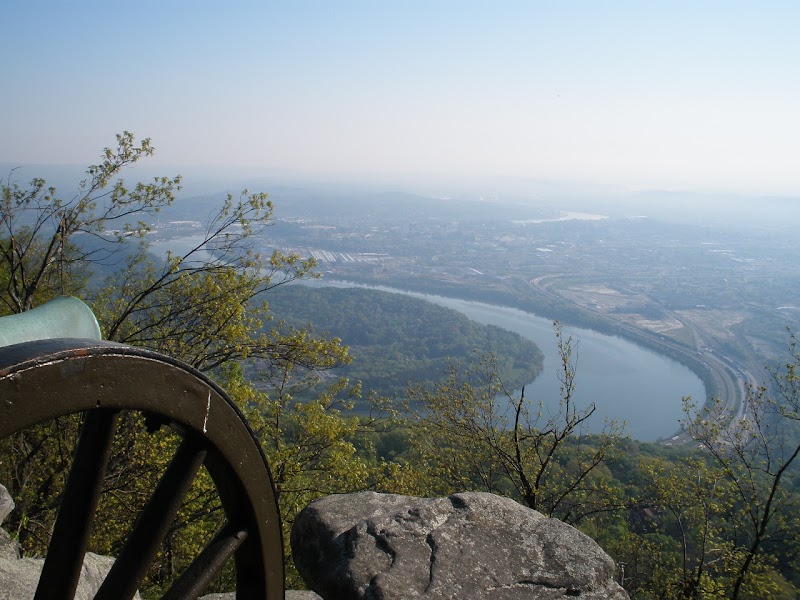
Point Park occupies the crest of Lookout Mountain at 1,700 feet, the position from which Confederate forces controlled the high ground above Chattanooga and could observe — and threaten — every supply line into the Union-occupied city below through the autumn of 1863. The Battle of Lookout Mountain on November 24, 1863 has entered Civil War legend as "The Battle Above the Clouds": morning fog lay so thick across the mountain's face that observers on the valley floor could hear the firing of muskets and artillery but could see nothing — the entire assault was invisible, conducted above the cloud line by Union forces under General Joseph Hooker scrambling up terrain that Confederate commanders had considered impregnable. By afternoon the fog had burned away and the blue-clad soldiers were visible on the mountain's summit, having dislodged the Confederate defenders in a tactically improbable assault that electrified the Northern press and became one of the war's most romanticized engagements. The park's main overlook — a stone platform at the mountain's crest — provides a sweeping panoramic view of the Tennessee River's extraordinary Moccasin Bend, a near-perfect horseshoe curve visible 1,700 feet below, with the city of Chattanooga beyond it and the ridgelines of Missionary Ridge and Signal Mountain completing the horizon. This is the view that made Chattanooga militarily critical: controlling it meant controlling the gateway between the eastern and western theaters of the war. At the park entrance stands the New York Peace Monument, a striking 95-foot obelisk erected in 1910 as a symbol of national reconciliation between North and South. Point Park is part of the larger Chickamauga and Chattanooga National Military Park, established by Congress in 1890 as the first national military park in the United States — a precedent that launched the entire American battlefield preservation movement.
🍽️
Lunch
Rock City Gardens
Rock City Gardens
4.7
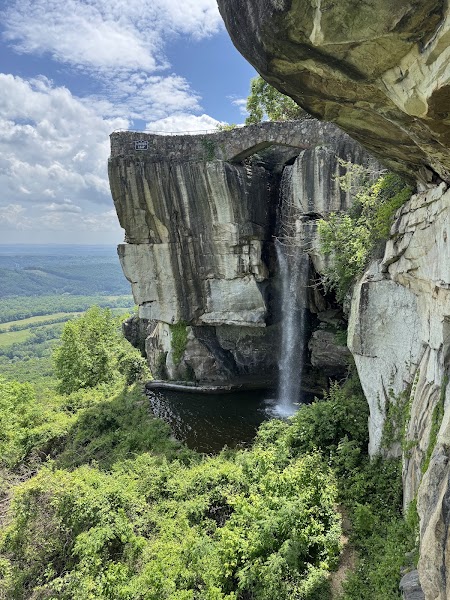
Developed by Garnet Carter and opened to the public in 1932, Rock City is a natural garden laid out among the ancient Appalachian sandstone formations along the Lookout Mountain ridgeline — a landscape of massive boulders, narrow crevices, hanging suspension bridges, and wooded ravines through which the 0.75-mile Enchanted Trail winds in a series of surprises. The signature attraction is Lover's Leap, a natural rock outcrop at the trail's end from which — on a sufficiently clear day — visitors are said to be able to see into seven states simultaneously: Georgia, Tennessee, Alabama, North Carolina, South Carolina, Virginia, and Kentucky, with the Blue Ridge and the Appalachians receding in successive ranges toward the horizon. The famous "See Rock City" barn roofs, painted by Clark Byers on farmhouse and barn rooftops across 19 states during the 1930s, 1940s, and 1950s, are among the most recognizable artifacts of American roadside advertising culture — at their peak, over 900 barns carried the message. The trail's famous passages include "Fat Man's Squeeze," a narrow corridor between two boulders just wide enough to admit an average adult sideways, and Swing-A-Long Bridge, a suspension footbridge over a wooded valley. The gardens support over 400 native plant species in their natural rock-garden setting and host elaborate seasonal lighting installations that draw large crowds in the fall and winter.
🍽️ Lunch12:00 PM
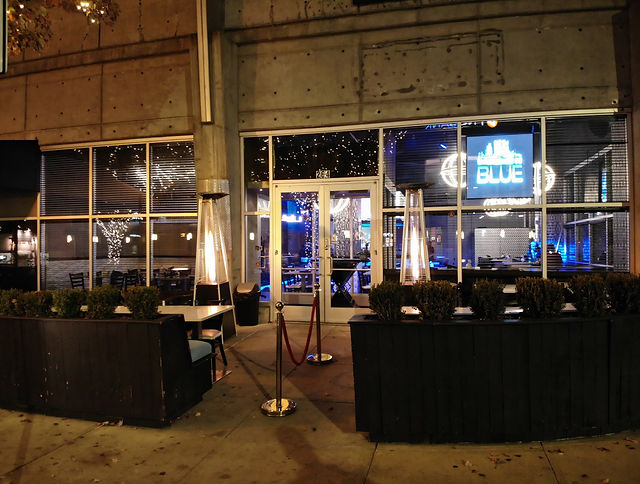
Bleu Restaurant & Lounge
A reliable lunch option near Lookout Mountain, Bleu serves a broad American menu in a relaxed setting convenient to the Rock City and Point Park visits.
3.6$$bar📍 Maps →
3 options · tap to switch
☀️
Afternoon
Lookout Mountain Incline Railway
4.4
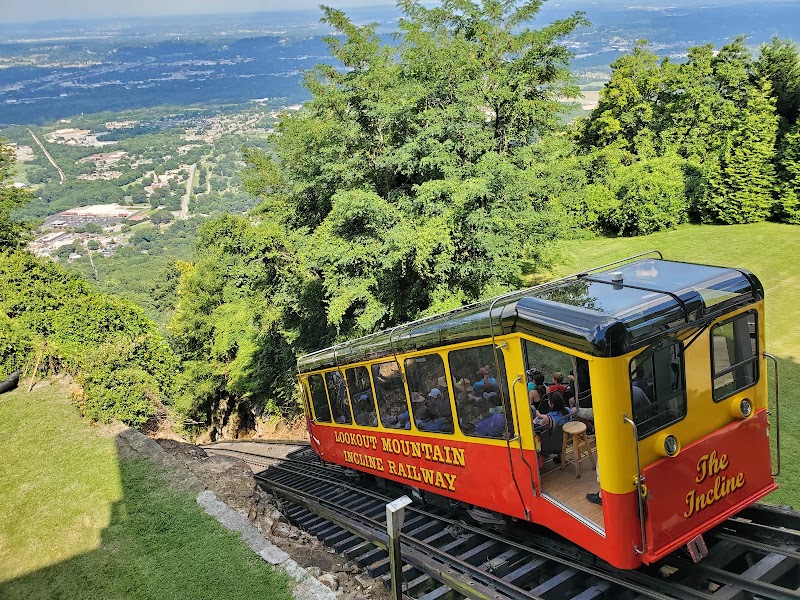
Opened in 1895 and designated a National Historic Landmark, the Lookout Mountain Incline Railway makes a 4,600-foot journey from the base station at St. Elmo, in Chattanooga's historic southside neighborhood, to the summit of Lookout Mountain at a maximum grade of 72.7 percent — making it the steepest passenger railway in the world, a distinction it has held for over a century. The two historic wooden passenger cars operate on a counterbalance principle: as one car ascends the mountain, the other descends on the same pair of tracks, the two cars passing each other at a turnout midway up the slope, the weight of the descending car helping to pull the ascending one. The views through the car windows as the mountain falls away below — Chattanooga spread across the valley floor, the Tennessee River's bends catching the afternoon light, the ridge of Signal Mountain on the far side — are among the finest you can experience from a railway car in the American Southeast. The Incline has been in continuous operation for over 125 years without a serious accident, a safety record as remarkable as its engineering.
🌙
Evening
📍
Chattanooga Southside District
Chattanooga's Southside district is a walkable restaurant and bar neighborhood a short drive from the Incline Railway's base station, centered on a cluster of converted industrial buildings that now house breweries, restaurants, and music venues. Tennessee Brew Works operates a large taproom here; the district offers scenic views of the Tennessee River from the pedestrian bridges crossing it.
🛏️
The Dwell Hotel Chattanooga or The Chattanoogan Hotel
The Dwell Hotel is a boutique art-deco property in the Southside district with a rooftop bar and intimate, design-forward rooms that make it a favorite among design-conscious travelers — its location puts the Incline Railway, the RiverWalk, and the Southside restaurant scene all within walking distance. The Chattanoogan is a full-service hotel in the main downtown district closer to the Tennessee Aquarium and the Bluff View Art District, offering a more conventional upscale experience with easy access to the next day's downtown itinerary.
Day 2Downtown Chattanooga

Day 2Downtown Chattanooga

🚗 15 min driving📍 6 stops
🌅
Morning
🚗
Drive
Lookout Mountain, TNDowntown Chattanooga, TN
15 min8:00 AM8:15 AM
Tennessee Aquarium
Tennessee Aquarium
4.7
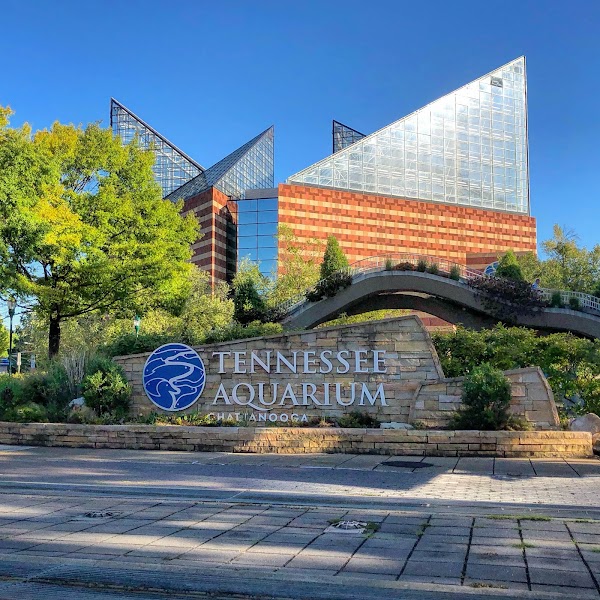
When the Tennessee Aquarium opened on the Chattanooga riverfront in May 1992, it was a bold urban experiment: a $45-million freshwater aquarium in a mid-sized Southern city that had been struggling with deindustrialization for two decades, built on the theory that a world-class cultural institution on the river's edge could anchor the revitalization of a declining downtown. The theory proved correct. The aquarium drew 1.2 million visitors in its first year, far exceeding projections, and its opening is credited by urban planners and historians as the catalyst for one of the most remarkable urban renewals in American history — the transformation of a city that had been named the most polluted in America in 1969 into an outdoor recreation and cultural destination. The facility now comprises two buildings. The River Journey building is the world's largest freshwater aquarium, tracing a single raindrop's journey from the Appalachian headwaters through successive river habitats to the Gulf of Mexico — past river otters, snapping turtles, paddlefish, giant catfish, freshwater stingrays, and the extraordinary diversity of native fish species that make the Tennessee River system the most biologically diverse river in North America. The Ocean Journey building presents saltwater ecosystems ranging from Caribbean coral reefs to the cold deep ocean, with a butterfly garden and living coral exhibits. Combined, the two buildings house over 12,000 animals representing more than 800 species, and the aquarium receives over 900,000 visitors annually — a number that has remained remarkably stable for three decades.
🍽️
Lunch
🍽️ Lunch9:15 AM
Bridgeman's Chophouse
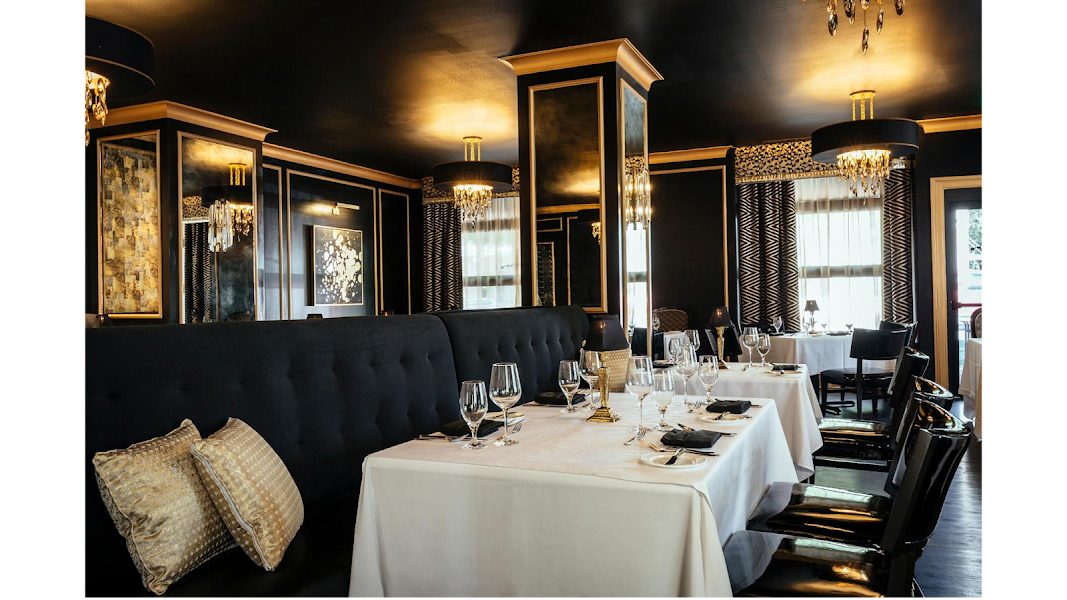
An upscale steakhouse in Chattanooga's downtown district offering Tennessee River views and a classic chophouse menu, Bridgeman's is a polished choice for a proper sit-down lunch between the aquarium and the afternoon's museum and bridge visits.
4.5$$$restaurant📍 Maps →
3 options · tap to switch
☀️
Afternoon
Hunter Museum of American Art
4.7
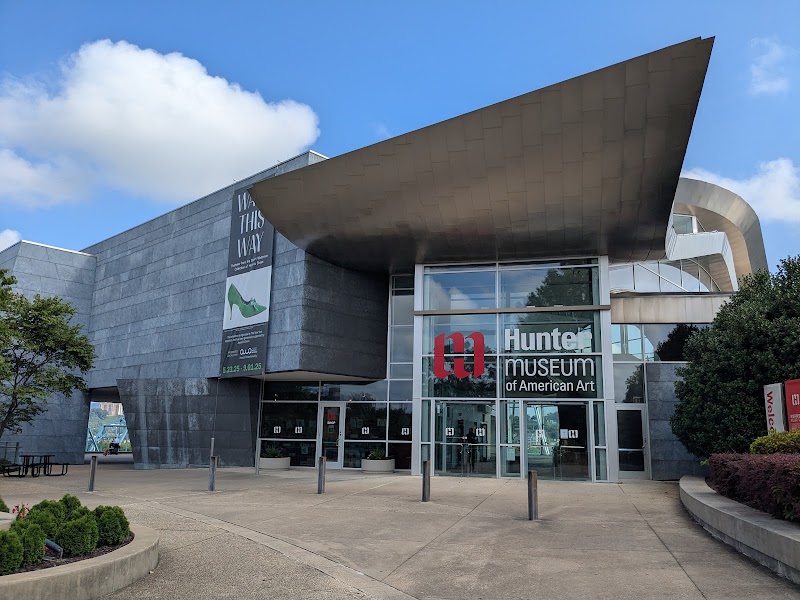
The Hunter Museum occupies one of the most dramatically sited positions of any American art museum — a limestone bluff forty feet above the Tennessee River in Chattanooga's Bluff View Art District, with commanding views up and down the river and across to Lookout Mountain. The building itself is an architectural argument across a century: a gracious 1904 Classical Revival mansion that was originally the home of Benjamin Thomas, one of the two entrepreneurs who acquired the original Coca-Cola bottling rights from Asa Candler for one dollar in 1899 and built a fortune from them; a bold 1975 Modernist addition in concrete and glass cantilevered over the bluff; and a 2005 contemporary wing by the architect Randall Stout that extends the complex along the bluff's edge in a form inspired by the curves of the Tennessee River below. The permanent collection of approximately 2,000 works spans American art from the 18th century through the contemporary moment, with particular depth in American Impressionism, the Hudson River School landscape painters, and post-World War II abstraction. Major traveling exhibitions rotate through the contemporary wing on a regular schedule. The bluff-top sculpture garden, with its views of the river and the mountains beyond, is itself a compelling reason to visit even for those less interested in the galleries — it is among the finest outdoor museum spaces in the South.
Walnut Street Bridge
4.8
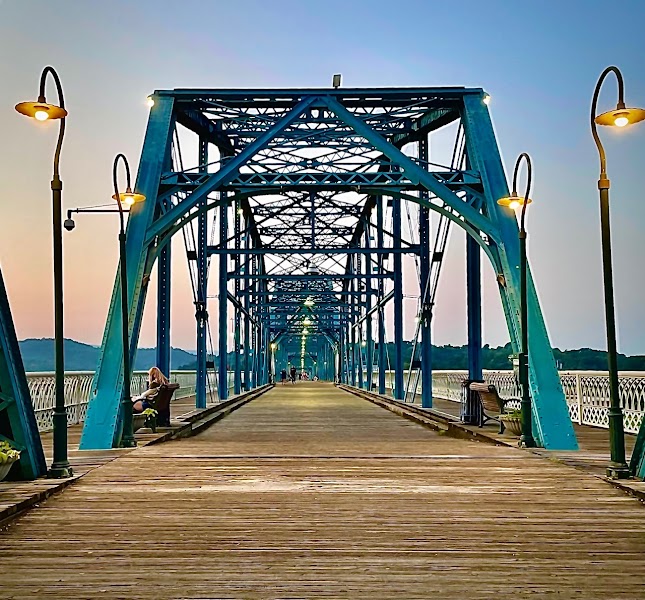
Built in 1891 and stretching 2,376 feet across the Tennessee River, the Walnut Street Bridge is the longest pedestrian bridge in the world and is listed as one of the oldest surviving metal highway bridges in the American South — a pin-connected through-truss structure of the type that once carried vehicles across rivers throughout the region but has largely vanished from the landscape. The bridge was decommissioned from vehicle traffic in 1978 when its structural condition had deteriorated beyond economic repair, and it sat idle for fifteen years before Chattanooga's riverfront revitalization movement restored it as a pedestrian and bicycle crossing in 1993 — one of the early signature projects of the same urban renewal that the Tennessee Aquarium had catalyzed. Walking across it, the views are exceptional in both directions: downstream toward the broad curve of the river past the aquarium and the downtown skyline, and upstream toward the looming mass of Lookout Mountain to the south and Signal Mountain to the north, with the sun on the river between them.
🌙
Evening
Bluff View Art District Evening Stroll
4.6
The Bluff View Art District in the early evening — galleries lit from within, the sculpture garden visible against the dimming sky over the river, the Tennessee Riverwalk extending in both directions below the bluff — is one of the most pleasant urban walks in the Southeast. Several gallery spaces remain open into the evening hours.
🛏️
The Dwell Hotel or The Chattanoogan Hotel (night 2)
Return to your hotel from night one — The Dwell Hotel in the Southside district or The Chattanoogan in the main downtown area — both within easy driving distance of the Chickamauga battlefield for the morning departure.
Day 3Chickamauga Battlefield, GA

Day 3Chickamauga Battlefield, GA

🚗 2 hr 30 min driving📍 4 stops
🌅
Morning
🚗
Drive
Chattanooga, TNChickamauga Battlefield, GA
30 min8:00 AM8:30 AM
Chickamauga & Chattanooga National Military Park — Visitor Center & Battlefield Tour
4.8
The Battle of Chickamauga, fought September 18-20, 1863, was the bloodiest two-day battle of the entire Civil War. In two days of fighting in the dense scrub-oak forests of northwestern Georgia, the opposing armies of General William Rosecrans (Union) and General Braxton Bragg (Confederate) suffered a combined 34,624 casualties — killed, wounded, captured, or missing — surpassing even Antietam and second overall among Civil War battles only to the three-day carnage at Gettysburg fought just two months earlier. The battle's geography was its defining characteristic: the tangled second-growth forest so restricted visibility that units became lost, flanks were exposed without warning, and the fog of war was literal as well as metaphorical. On the afternoon of September 20, a catastrophic miscommunication led Union General Rosecrans to order a division out of line to fill a gap that did not exist, creating a real gap just as Confederate General James Longstreet's corps launched an assault directly into it — the single most devastating breakthrough of any Civil War battle. The Union right collapsed and streamed back toward Chattanooga in near-rout, and Rosecrans himself fled the field believing the army was destroyed. It was not destroyed, because of General George H. Thomas. A Virginian who had remained loyal to the Union, Thomas gathered the retreating fragments of several corps on Snodgrass Hill in the southern part of the battlefield and held there against repeated Confederate assaults through the afternoon and evening, allowing the rest of the army to reach Chattanooga. His stand earned him the sobriquet "Rock of Chickamauga" and the permanent gratitude of the United States Army. The visitor center, operated by the National Park Service, houses outstanding interpretive exhibits on the battle and its context in the western campaigns of 1863. The 5,400-acre battlefield is the best-preserved Civil War battlefield in terms of original landscape, the dense second-growth forest closely resembling the tangled woodland where the armies fought, and 1,400 monuments, cannon, and iron tablets mark the positions of individual units with a specificity found at no other Civil War site.
🍽️
Lunch
Snodgrass Hill & Brotherton Cabin Battlefield Sites
4.8
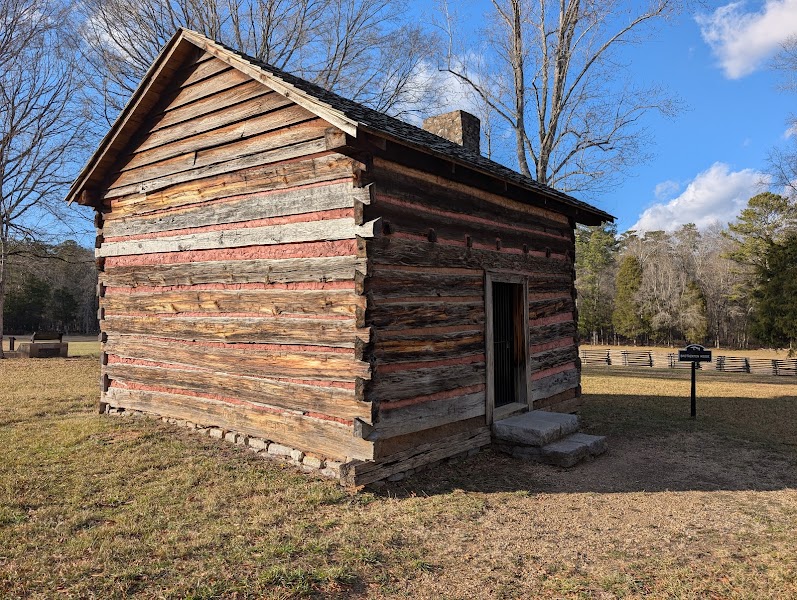
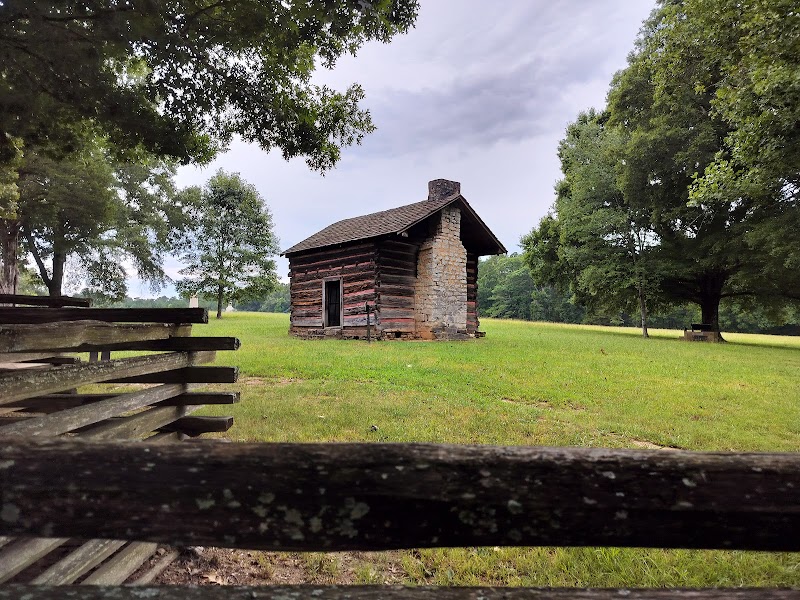
These two sites mark the pivotal moments of the battle's second day. The Brotherton Cabin — a log farmhouse that still stands in its original location on the battlefield — marks the exact spot where Longstreet's Confederate forces poured through the gap inadvertently created in the Union line, the breakthrough that sent half the army streaming north toward Chattanooga. A quarter mile south, Snodgrass Hill is where Thomas's corps made its stand, repulsing assault after assault through the afternoon of September 20 with units running out of ammunition and fixing bayonets. Standing on the hill's modest crest, surrounded by the monuments of the regiments that defended it and the woods through which the Confederate attacks came, makes the desperation of that afternoon palpable in a way that no museum exhibit can replicate.
🍽️ Lunch10:30 AM
Champy's Famous Fried Chicken
A Chattanooga institution known across the region for its fried chicken, Champy's serves lunch in a lively roadhouse atmosphere that is the right antidote to a morning spent contemplating the scale of 19th-century industrial warfare.
4.3$$restaurant📍 Maps →
3 options · tap to switch
☀️
Afternoon
Fuller Gun Collection & Chickamauga Creek
4.8
The Claud Fuller Collection of American military arms, housed at the park visitor center, is one of the finest collections of American military firearms in existence, tracing the evolution of infantry weapons from the flintlock muskets of the Revolutionary War through the breech-loading and repeating rifles of the Civil War — a technological arc that directly explains why Civil War battles produced casualties on a scale that earlier generations of generals had not imagined possible. Nearby, Chickamauga Creek itself winds through the battlefield's southern reaches, accessible on several short trails; its Cherokee name, most historians agree, translates as "River of Death" — a name the creek bore long before September 1863 gave it a new reason to.
🌙
Evening
🚗
Drive
Chattanooga, TNAtlanta, GA
2 hr5:00 PM7:00 PM
Plan your own escapeExplore more trips →