🥾 ActiveDay trip · from Savannah, GA
Okefenokee: Paddling the Land of the Trembling Earth
Two hours west of Savannah, the Okefenokee National Wildlife Refuge is the largest blackwater swamp in North America — 438,000 acres of cypress cathedral, open prairie, and slow dark water where alligators glide beneath your canoe and sandhill cranes bugle across the peat islands. The Seminole called it 'land of the trembling earth' because the peat islands float on open water and shake underfoot — a description that loses nothing in translation once you're standing on one. A guided boat tour or wilderness canoe through Suwannee Canal channels is one of the most dramatic paddling experiences in the Southeast.
Day 1 — Okefenokee National Wildlife Refuge, Folkston, GA
Day 1 — Okefenokee National Wildlife Refuge, GA
Day 1 — Okefenokee National Wildlife Refuge, GA
🚗 4 hr driving📍 3 stops
🌅
Morning
🚗
Drive
Savannah, GA → Okefenokee NWR East Entrance, Folkston, GA
2 hr
Take I-95 south to US-17, then US-17 and GA-23/121 southwest to Folkston. The East Entrance (Suwannee Canal Recreation Area) on Hwy 121 south of Folkston is the most accessible entry point for day visitors.
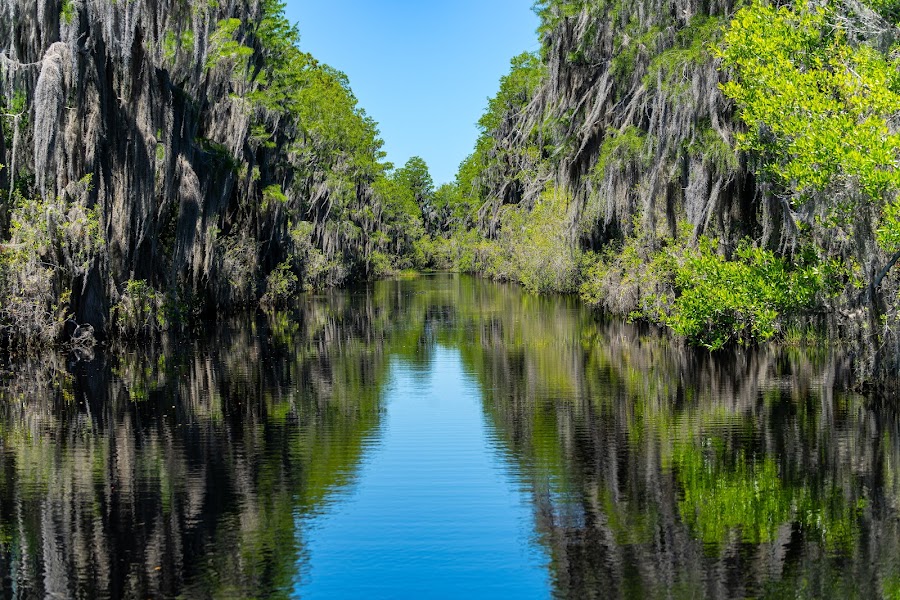
Suwannee Canal — Canoe or Guided Boat Tour
★ Reviews →The Suwannee Canal was dug in the 1890s by the Suwannee Canal Company, which attempted to drain the swamp for logging and agriculture. The project failed spectacularly — the swamp refused to drain — but left a 11.5-mile straight-cut channel penetrating deep into the refuge's interior, and this canal now serves as the primary paddling route from the East Entrance into the swamp's heart. Paddling it is one of the most extraordinary wildlife experiences in the eastern United States.
Alligators are guaranteed: they are so habituated to canoes that they simply move aside or watch with prehistoric indifference as you pass within arm's length. On a typical day in the canal, you will see dozens of alligators in various sizes — from hatchlings the length of your forearm to ancient bulls of ten feet and more that have been in this swamp for half a century. Great blue herons stand motionless in the shallows. Anhingas perch with wings spread in dead snag trees, drying their feathers in the sun after diving for fish. Sandhill cranes, standing four feet tall and grey as pencil lead, call their prehistoric rattling bugle across the open prairie stretches. Purple gallinules walk on lily pads. Pitcher plants and sundew — carnivorous plants that evolved protein independence in the nutrient-poor peat — line the canal margins. Giant American white water lily pads, three feet across, cover the open water of the side channels.
~1 hr📍 See location
🍽️
Lunch
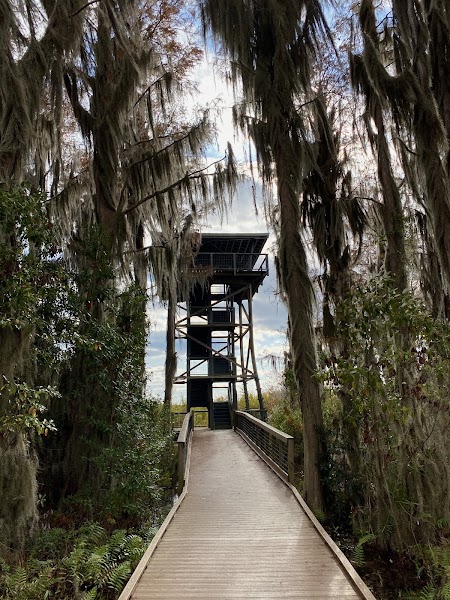
Chesser Prairie Boardwalk & Visitor Center
★ Reviews →The Okefenokee NWR East Entrance Visitor Center provides excellent interpretive context for the swamp's ecology: the role of fire in maintaining the open prairie patches, the peat geology that makes the islands float, the life history of the American alligator, and the cultural history of the Seminole and later European homesteaders who tried and largely failed to make a living in this vast and uncompromising wilderness. The Chesser Prairie Boardwalk extends from the visitor center half a mile over open prairie and blackwater channels, providing elevated views of the swamp landscape and excellent wildlife viewing in the prairie margins. From the observation tower at the boardwalk's end, the full extent of the Okefenokee's open prairie stretches to the horizon.
~1.5 hrs📍 See location
☀️
Afternoon
Trembling Earth Trail & Peat Island Walk
★ Reviews →The Trembling Earth Nature Trail near the East Entrance winds through mature cypress swamp and over several floating peat islands — the 'trembling earth' of the Seminole name. Stepping onto a floating peat mat, you can feel the ground move underfoot as the deep peat layer, saturated with water and underlain by open water, undulates with each step. This is not metaphor or exaggeration but a measurable physical phenomenon: the peat layer in some parts of the Okefenokee is only a few feet thick and floats freely on the water below, responding to pressure exactly as a water bed would. Cypress trees rooted in this floating peat have developed buttressed trunks of extraordinary width and knee systems that project above the waterline to gather oxygen — adaptations to the permanently anaerobic soil of the swamp.
~1.5 hrs📍 See location
🌙
Evening
🚗
Drive
Okefenokee NWR East Entrance, Folkston, GA → Savannah, GA
2 hr
← All Savannah trips
More getaways from Savannah
Cumberland Island: Wild Horses, Wilderness Beach & Carnegie Ruins — Day trip🥾Cumberland Island Two-Day: Deep Wilderness & Plum Orchard — Weekend🥾Sea Islands Active Circuit: Cumberland, St. Simons & Sapelo — Long weekend🥾Beaufort & the Gullah-Geechee Heartland — Day trip🏛️Beaufort, Penn Center & the Hunting Island Lighthouse — Weekend🏛️Lowcountry Cultural Circuit: Beaufort, Penn Center & Edisto Island — Long weekend🏛️Tybee Island: Forts, Lighthouses & Low Country Boil at Sunset — Day trip🌿Tybee Island Weekend: Forts, Sunsets & Little Tybee by Kayak — Weekend🌿
© 2026 theweekendgetaways.com · All itineraries are original content. Terms
Plan your own escapeExplore more trips →